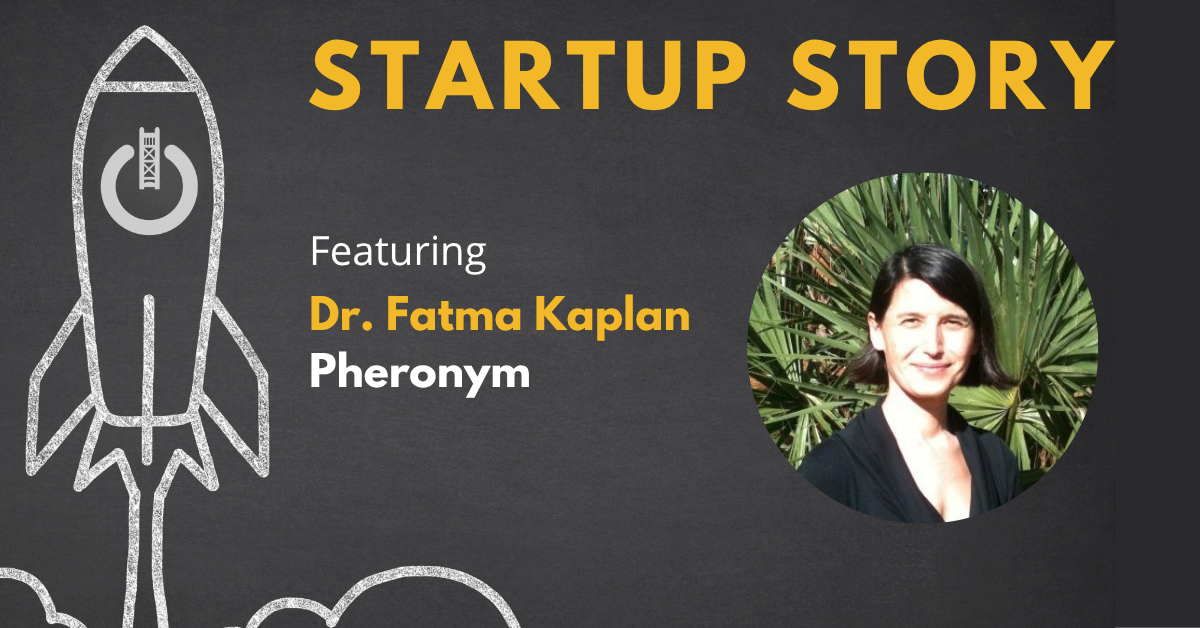
Agriculture faces a growing challenge: how to protect crops while reducing reliance on pesticides that can harm people, wildlife, and the environment. For Dr. Fatma Kaplan, CEO and cofounder of Pheronym, the answer began with a scientific discovery and a determination to bring it out of the laboratory and into the field.
Raised on a family farm in Türkiye and later trained as a scientist in the United States, Dr. Kaplan built a career focused on solving agricultural problems. Today, Pheronym is developing pheromone-based technologies that help beneficial nematodes become more effective pest control tools while supporting healthier farming practices.
In this Startup Story, Dr. Kaplan shares how her background in agriculture shaped her career, the challenges of transitioning from scientist to entrepreneur, and her vision for the future of sustainable pest management.
Note: Responses have been lightly edited for length and clarity.
From the Farm to the Laboratory
Before founding Pheronym, what originally inspired you to start the company and pursue agricultural biotechnology?
Dr. Kaplan: I started Pheronym because I wanted my discoveries to have real world impacts. Starting a company turned out to be the best way to bring the nematode pheromone technologies that I had discovered to farmers. My initial plan was to continue my research as a professor at a research university where I could conduct laboratory and field trials in collaboration with other university scientists and the USDA-ARS. Then I would work with ag-input companies like BASF, Bayer, Corteva, and Syngenta and nematode manufacturers like e-nema, Koppert, and BioLogic’s to commercialize my discoveries. Starting Pheronym made it possible to bring nematode pheromones to the market.
Growing up on a family farm in Türkiye, how did those experiences shape the way you think about agriculture and innovation today?
Dr. Kaplan: I know first-hand how much pest management makes a difference in farmers’ yield. Since I started college studying to be an Agricultural Engineer when I was 15, I was influenced by both farmers’ experience and what higher education had to offer. In college, I learned about the negative effects of pesticides on our health and soil, and the benefits of biological control. So, I wanted to work on something that eliminates toxic pesticides from farms. I had a unique perspective on how I can solve farmers’ problems. After college, I had a fellowship from the Türkish government to get a Master and Ph.D. in biotechnology in the US, where I gained more tools to solve farmers’ problems. I learned about molecular breeding, genetic engineering, and synthetic biology, including ways to reduce long breeding timelines or target traits that can be difficult to address through conventional breeding methods. During postdoc, I had the opportunity to identify the first mate finding pheromone from the model nematode Caenorhabditis elegans, which is a microscopic roundworm that enabled many Nobel prize winning discoveries in Medicine. I knew how effective pheromones were used for insect control above ground as well as how devastating plant parasitic nematodes could be for farmers. Nematode pheromones can have enormous impact on farmers’ lives.
Taking the Leap Into Entrepreneurship
You had a successful scientific career before becoming a founder. What made you decide to take the leap into entrepreneurship?
Dr. Kaplan: Becoming an entrepreneur was not in my career plan. When I was a graduate student and postdoctoral trainee/researcher, we all thought the next step was to become an assistant professor at a research university. I did not realize that most scientists would never get a tenure track faculty position, or that women and immigrants had even worse chances of landing those positions. Most academic positions for immigrant women scientists are temporary positions without benefits or stability, like postdoctoral researcher, adjunct lecturer, and adjunct assistant professor. At best, they last a few years and have health benefits. At worst, they are a constant grind of 3 or 4-month contracts. This was a big problem between me and my goal of bringing the nematode pheromones to the market. I needed funds and resources. So, I took a leap into entrepreneurship.
What were some of the biggest challenges you faced transitioning from scientist to startup CEO?
Dr. Kaplan: There were a lot of challenges. It was like stepping into a totally new world. I didn’t know the rules and there was no rulebook for me to read. I quickly learned that I didn’t know how to commercialize a product. So, I got into a business incubator to find advisors, who helped me develop my first product concept, which is called NemastimTM, to control insect pests by improving the efficacy of beneficial nematodes. The advisors also helped me with another problem I had. I had an academic network which had no overlap with a business network. I leveraged my academic network to accomplish technical milestones, but that was not enough to bring a product to market. I had to develop a network in the business community and find the right ecosystem, which I found in California. One of our early business advisors introduced us to our first investor, IndieBio (now SOSV SF), which brought us to California. While I was at IndieBio in San Francisco, I expanded my network by joining the Tech Futures Group (TFG) and California Life Sciences Association FAST Fellows, where I met Dr. Pam Maronne, who is a leader in biopesticides and became a crucial advisor for Pheronym. Other networks I joined are Activate Entrepreneurial fellowship/Cyclotron Road at the Berkeley lab in Berkeley, Venture Catalyst at UC Davis, AgStart in Woodland, CA, and Startup Sac in Sacramento. Another hurdle is fundraising. I used my skills from academic training to write industry grants like Small Business Innovation Research (SBIR) grants and other industry grants which provide partial assistance. Grants are great, and they can get you started, but they don’t cover everything you need to develop a product. I needed more funds, but I did not know how to raise funds from investors, so I had to learn a lot including preparing a pitch deck, presentation deck, term sheets, etc.
Turning Research Into Real-World Impact
Was there a specific moment when you realized your research could become a real business and make an impact in agriculture?
Dr. Kaplan: I knew the moment I heard the project from my postdoc advisor in 2005. The project was to identify the first sex pheromone from the model nematode C. elegans. I knew insect pheromones were successfully used to control insect pests above ground. If I identify the nematode pheromones, this could be used to control nematodes, particularly plant parasitic nematodes, which are a major problem for agriculture in the soil. I identified the first mate finding pheromones from C. elegans as a mixture of ascarosides (ascr#2, ascr#3 and ascr#4) and published this work in Nature, a prestigious scientific journal, in 2008.
Pheronym focuses on non-toxic pest control solutions. Why is sustainable agriculture and reducing pesticide use so important to you personally?
Dr. Kaplan: I know from personal experience how our world is so connected from air to soil and water. The Chernobyl accident happened when I was in high school, and the winds, clouds and rain brought the radiation from Ukraine to my hometown in Türkiye. An incident in Ukraine affected our crops in the Black Sea in Türkiye. A decade later, several of my relatives developed cancer due to this incident in Ukraine. What we put in the soil or air had bigger impacts on our lives than we could imagine. Today, we know the pesticides’ effects on our environment, ground water, wildlife, humans and our quality of life or causing cancer. When I go outside, I should be able to step on the grass with my bare feet without worrying about being exposed to poisons. I want to leave a healthy planet with solutions that work in harmony with nature for future generations.
Agriculture Beyond Earth
You conducted the first agricultural biocontrol experiment in space at the International Space Station. What was that experience like and what did you learn from it?
Dr. Kaplan:
It was an amazing experience conducting an experiment in space at the International Space Station. When I left academia, I did not think I would have an opportunity to conduct an experiment in space. Sometimes, life surprises you!
We have learned that beneficial nematodes can go through 10 cm sand find the host insect, invade the insect and kill the insects in microgravity. It can develop full life cycle in space. Beneficial nematodes in collaboration with their symbiotic bacteria can kill the insects in space. The infective juvenile stage can travel space for about a month without losing its infectivity. The results of the first part are published in a Nature Partner Journal called npj Microgravity.
Building the Future of Pest Control
What has been one of the most rewarding moments so far in building Pheronym?
Dr. Kaplan: The most rewarding thing about building Pheronym is watching my ideas become reality. The first successful laboratory tests in the soil (2018) and then greenhouse trials with agriculturally important pests (2019) followed by efficacy field trials in orchards (2021 and 2022) against pecan weevil all validated my idea of using pheromones to make beneficial nematodes more effective. This was also tested successfully for foliar invasive insect pest, whitefly (2024). Now we can control nematode behavior in the field conditions with pheromones.
Demonstrating manufacturing feasibility was similarly rewarding. We demonstrated proof of concept for commercial manufacturing for the first time in shake flasks (2022). Then we successfully transitioned to benchtop bioreactors (2024) and scaled up to 5L in benchtop bioreactors in 2024 and 2025. Now we are looking forward to piloting standard stainless-steel bioreactors, which is our next technical milestone. We recently got some funding from National Science Foundation in 2026, but we need more so we are raising funds.
Looking ahead, what is your long-term vision for Pheronym and the future of agricultural pest control?
Dr. Kaplan: In addition to our first product, Nemastim, we are developing two other products, PherocallTM to improve the soil microbiome and control plant-parasitic nematodes, and PherocoatTM to prevent plant-parasitic nematodes from infecting our crops. Nematode pheromones will provide eco-friendly pest management to farmers to control insect and nematode pests while nurturing the topsoil, so farmers can grow more food, leaving a healthy planet for future generations.
Pheronym has secured multiple grants and other sources of non-dilutive funding. What have you learned about funding a science-based startup, and how should founders think about balancing grants, revenue, and investment capital?
Dr. Kaplan: Funding a science-based biotech startup is difficult. Grants cover the science, but not legal, sales, or marketing. Founders should anticipate commercialization milestones and seek diverse funding sources, both dilutive and nondilutive, to achieve them.
At Pheronym, we follow a simple rule: every dollar received must drive a product milestone, and the data generated must serve at least one of the following purposes:
- Fundraising (dilutive or nondilutive) toward the next milestone
- Building assets through intellectual property
- Providing technical support for customers
- Creating product awareness through peer-reviewed publications, conference presentations, grower meetings, blogs, or technical reports
- Preparing sales documents
- Customer acquisition
This narrows down what kind of funding we pursue.
In 2017, we took accelerator funding and a USDA SBIR Phase I grant to prove our technology in the lab and greenhouse. Noticing that few ag professionals knew about beneficial nematodes or pheromones, we stayed alert for awareness-building opportunities. In 2019, an ISS National Laboratory grant let us run the first ag biocontrol experiment in microgravity. People still ask us about it enthusiastically. In 2020, an NSF SBIR Phase I grant funded scalable manufacturing development. A COVID supplement helped us interview 100 ag professionals and sharpen our commercialization roadmap. In 2021, Activate Fellowships and investments from Sacramento Angels and Thrive Ag helped us demonstrate scalable pheromone manufacturing and run field trials, generating data that strengthened two new patent families.
Additional investment from Shared Future Fund, Gigascale Capital, and Activate VPP bridged the gap between SBIR phases. SBIR Phase II then funded our transition from shake flasks to 5L bioreactors. With manufacturing derisked, we’re now raising capital for pilot production. Reach out to join us in bringing the first nematode pheromones to market.
About Pheronym
Pheronym is an agricultural biotechnology company that uses a new kind of pheromone to control nematodes. Its initial product helps beneficial insect-killing nematodes become more effective biological control agents. Additional products in development are focused on controlling plant-parasitic nematodes and improving soil health. The company’s mission is to provide environmentally friendly pest management solutions that help farmers protect crops while reducing reliance on conventional pesticides.
Wrap Up
Dr. Fatma Kaplan’s journey from a family farm in Türkiye to leading an agricultural biotechnology company highlights how scientific discoveries can create real-world impact when paired with persistence and entrepreneurship. Along the way, she navigated the transition from academia to business, built new networks, learned the fundamentals of fundraising, and continued advancing innovative technologies aimed at helping farmers. For founders, her story demonstrates that expertise in one field can become the foundation for building something entirely new when there is a clear mission and a willingness to learn along the way.
Interested in learning about more programs that support entrepreneurs? Join our newsletter here to stay updated on opportunities and resources.