Many entrepreneurs spend months, or even years, building a product they believe people want. They perfect features, invest time and money, and create detailed business plans before ever asking potential customers if the problem they’re solving is important.
That approach can be expensive.
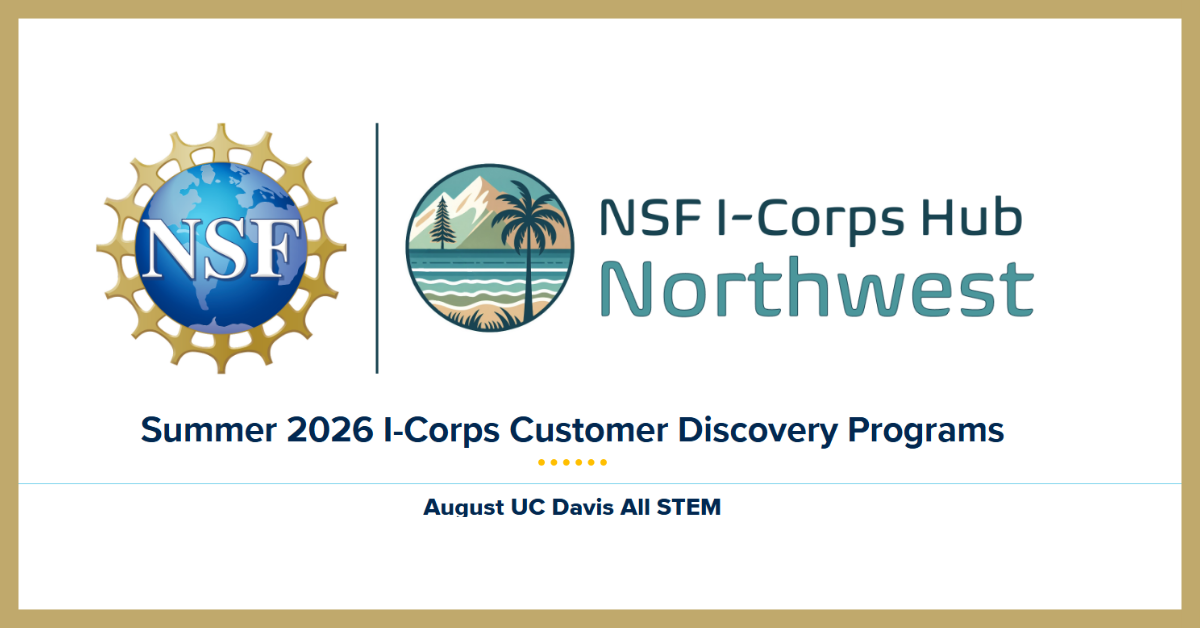
The NSF I-Corps Hub Northwest Regional Short Course at UC Davis helps founders, researchers, and innovators validate their ideas before investing too much time, money, or effort. If you’re developing a STEM-based innovation and want to understand whether there is real market demand, this free program provides a practical framework for testing your assumptions through customer discovery.
The upcoming August program is UC Davis’s final All STEM cohort of 2026. The final two I-Corps cohorts of the year will focus specifically on Planetary Health and AgTech, making this the last opportunity this year for innovators across a broad range of STEM industries to participate in an All STEM cohort.
Applications for the August cohort are now open, with a deadline of July 22, 2026.
What Is NSF I-Corps?
The NSF I-Corps Hub Northwest Regional Short Course is designed for early-stage teams working on technology or engineering innovations. Rather than focusing on writing business plans or building products, the program teaches participants how to understand their market by talking directly with potential customers.
Led by experienced entrepreneurs, this short online course introduces one of the most valuable skills an early-stage founder can develop: customer discovery. Customer discovery is the process of testing your assumptions by talking directly with potential customers before investing significant time and money into building a product. Participants learn how to identify customer segments, validate assumptions, define their value proposition, and better understand the industries they hope to enter.
Whether you are a university researcher, startup founder, student, or community innovator, the goal is the same: build something people actually need.
Learn What Your Customers Really Want
One of the biggest challenges for early-stage founders is learning whether their assumptions about customers are actually correct.
Throughout the program, participants conduct 20 customer discovery interviews. These conversations provide valuable insight into customer pain points, buying behavior, and whether a solution solves a meaningful problem.
By the end of the course, teams have a much clearer understanding of who their customers are, what they value, and how their innovation fits into the marketplace.
These lessons often save founders significant time by helping them avoid building products based on assumptions instead of evidence.
Who Should Apply?
The program welcomes a wide range of innovators, including:
- Early stage technology startups
- University faculty, researchers, postdoctoral scholars, staff, and students
- Community teams developing STEM-based innovations
- Entrepreneurs exploring science or engineering-focused business ideas
- Industry professionals interested in mentoring or supporting innovation
No previous business or commercialization experience is required. If customer discovery is new to you, this program was built with you in mind.
Applicants should form a team of two to four members and be prepared to actively participate throughout the course.
What You’ll Learn
During the course, participants will learn how to:
- Conduct meaningful customer discovery interviews
- Identify their highest value customer segments
- Build and test value propositions
- Use Lean Startup principles to evaluate ideas
- Present findings through concise storytelling
- Better understand the commercial landscape for their innovation
These skills can help founders make stronger business decisions while reducing the risks that often come with launching a new technology.
More Than a Course
Participants also gain access to a network of entrepreneurs, innovators, researchers, and mentors throughout the Northwest region.
For teams developing university-based intellectual property, successful completion of the Regional Short Course may also create a pathway toward the National NSF I-Corps Program. Teams that receive a Hub and instructor recommendation may qualify for additional training and potential access to a $50,000 NSF grant to support additional customer discovery and commercialization activities.
For many founders, the Regional Short Course becomes the first step toward turning promising research into a scalable business.
Program Details
Orientation: August 4, 2026 | 12:00 PM to 1:00 PM
Workshop Dates:
- August 18 | 3:00 PM to 6:00 PM
- August 25 | 3:00 PM to 6:00 PM
- September 1 | 3:00 PM to 6:00 PM
Application Deadline: July 22, 2026
Learn more here and submit your application here.
The program is conducted online through Zoom, making it accessible to participants throughout the Northwest region.
Wrap-Up
Every successful startup begins by understanding the customer.
If you’re developing a STEM innovation and want to improve your chances of building something with real market demand, the NSF I-Corps Hub Northwest Regional Short Course offers practical tools, expert guidance, and a proven customer discovery process to help you move forward with confidence.
Applications close on July 22, 2026. If you’re ready to validate your idea, strengthen your business model, and connect with a community of innovators, now is the time to apply.
Interested in learning about more programs that support entrepreneurs? Join our newsletter here to stay updated on opportunities and resources.