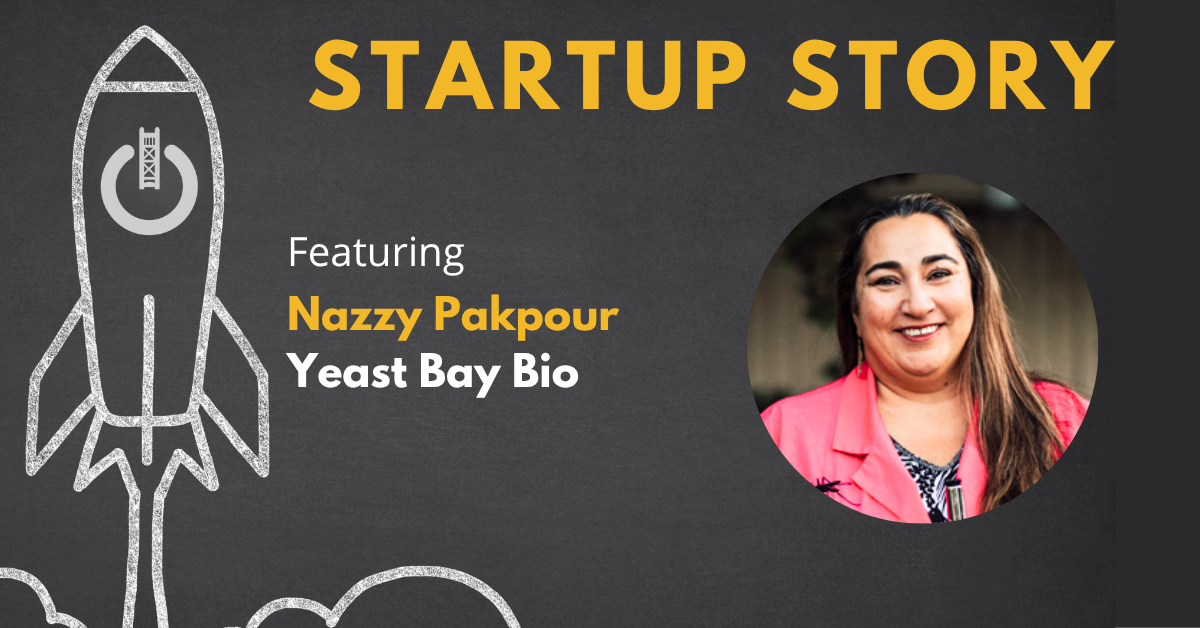
Nazzy Pakpour never expected to have an opportunity to reduce the world’s reliance on chemical pesticides. But when the idea that became Yeast Bay Bio emerged, her background in entomology, microbiology, industrial biotechnology and business suddenly came together in a new way.
Yeast Bay Bio is developing a pest control technology that uses yeast to produce RNA designed to target specific insects. The company’s first target is cockroaches, with the broader goal of creating effective pest control products that reduce reliance on traditional chemical pesticides. Yeast Bay Bio is also one of the 10 finalists selected to compete in the Startup World Cup Sacramento Regional on October 20, where the company will pitch for the opportunity to advance to the Startup World Cup Grand Finale in San Francisco.
We spoke with Pakpour about her path from scientist to startup founder, the science behind Yeast Bay Bio, the challenges of building a biotechnology company, and what she has learned during the company’s first year.
From Scientist to Startup Founder
Your career has taken you from entomology and microbiology research to industry and now entrepreneurship. What led you to make the leap and become a startup founder?
Nazzy: I’ve made a few leaps, so becoming a founder wasn’t a single dramatic moment. Leaving academia in 2020 for Novozymes, now Novonesis, was the much scarier one. I had a lot to learn about industrial microbiology coming from an academic setting. I also found I liked the business side more than I expected. I play a lot of strategy board games, and business scratches the same itch.
Leaving Novonesis was about what Yeast Bay Bio could be. There’s a saying that we’ve all picked fruit from trees we didn’t plant and drunk from wells we didn’t dig, so we plant trees and dig wells for the people who come after us. I never expected a chance to do it at a global scale until this came along, and I couldn’t pass the opportunity to fundamentally reduce our reliance on chemical pesticides.
As for the leap into founding, it didn’t feel like one. Everything that goes into being a founder is something I had done before, just never all at once. Starting a lab, building a research program, learning how science becomes a product. The novel part is doing them concurrently.
What problem did you see in the pest control industry that made you believe there was an opportunity to build Yeast Bay Bio?
Nazzy: There are two problems, and they’re simple. As we learn more about how toxic chemical pesticides are to the environment, to us, to our pets, and to pollinators, we’re regulating them and pulling them off the market. At the same time, we’ve used them so heavily that insects are becoming resistant to what’s left. Put those together and pest control operators have an ever-shrinking toolkit.
These are people on the front lines of public health who are largely invisible and, in a lot of ways, neglected. I saw an opportunity to give them new tools that are effective but safer, for them as individuals, for their customers, and for the environment, while still killing the insect.
How Yeast Bay Bio’s Technology Works
For someone without a science or biotech background, how would you describe what Yeast Bay Bio is building and why it is different from traditional pest control products?
Nazzy: We take yeast, the same yeast used in bread and beer, and modify it to make a piece of RNA that matches the RNA of a specific insect. Our first target is cockroaches. We kill the yeast, dry it, and mix it into cockroach bait. When the cockroach eats it, our RNA binds to its RNA and shuts off genes it needs to survive, so it gets sick and dies.
Because the match has to be exact, the bait is safe for everything else. Your RNA doesn’t match. Your dog’s doesn’t. A bee’s doesn’t. Anything else that eats it is fine.
Most people already understand that chemical pesticides aren’t great. Ask anyone if they want them sprayed in their home or office and they’ll say no. The specificity is what makes ours a better tool, and it still kills the insect you want gone. Our tagline is kill the pest, but not the rest.
Biotech companies can face a long path from an idea in the lab to a product in the market. What have been some of the biggest challenges you have encountered while building Yeast Bay Bio, and how have you worked through them?
Nazzy: Our biggest challenge is the timeline. Investors want to see revenue sooner, and that makes complete sense when you’re writing a check. But a company like ours requires investing in a longer-term vision. We have a regulatory gate to clear. We need EPA approval, and we need it to establish trust and safety with the public. We want to be a trusted brand, and that process takes time.
So the real challenge is finding investors who understand the timeline and are in it for the long haul. We’ve been fortunate. Our angels and Cal Innovation Fund have been on board with us from the start and are heavily involved in the process. It makes the work more fun, and it sets a high bar for who we bring in next.
Turning Research Into a Viable Business
How did you know the science behind Yeast Bay Bio had the potential to become a viable business rather than remaining primarily a research project?
Nazzy: I was working at Novonesis, one of the most renowned industrial biotechnology companies in the world. Novozymes was formed in 2000 when Novo Nordisk split into three companies, and today it’s the global leader in industrial enzymes and microbial solutions. So I learned very intimately how the economics of yeast fermentation work and just how low cost and efficient it is in energy and inputs compared to other processes.
When I had the idea for this product, a huge part of my confidence came from knowing we could make something without a green premium. Nobody would have to pay more for the safer option. We could compete on cost with chemical insecticides, and that has been a major limiting factor in why RNAi technology hasn’t been more widely deployed.
What has surprised you most about becoming a founder and CEO compared with your previous work as a scientist and researcher?
Nazzy: What has surprised me most is how much my personality plays into it. I’m extroverted, gregarious, boisterous. In most highly technical settings I had to learn to turn that knob down. One of the fun parts of the startup world is that I’m often asked to turn it the other way, to be more authentic, to be more Nazzy. That has been delightful.
This is the first role where I get to bring all of myself and all my various skills and interests. I don’t have to soften my edges to be more palatable. It’s okay to be loud and brash and optimistic and unapologetic.
What’s Next for Yeast Bay Bio
What stage is Yeast Bay Bio at today, and what are the most important milestones you are working toward next?
Nazzy: Right now we’re deep into proof of concept science. We’ve built our first and second generation yeast strains and we’re running the cockroach experiments. The goal is to get some lovely dead cockroach data and take that out to raise our seed round. That funds the data package we need for EPA approval and the fermentation scale up.
Our pre-seed is closed, so we have what we need to finish the proof of concept work.
Looking back at the early stages of Yeast Bay Bio, is there anything you would approach differently knowing what you know now?
Nazzy: I still feel like we’re in the early stages. We just celebrated our one-year anniversary in September.
I wouldn’t change much. My philosophy is that you have to throw yourself off the cliff if you want to learn how to fly. I learn best by doing, so that’s what I did. I got started and started doing things. I’m not one to tinker indefinitely chasing perfect. Rolling my sleeves up and trying things is exactly what got us to where we are.
What advice would you give to scientists, researchers, or other first-time founders who have an idea or technology with commercial potential but are unsure how to take the first step toward building a company?
Nazzy: We’re uniquely situated here. California is the hub of startup culture and there are a million events, workshops, seminars, free classes, networking opportunities. My advice is to just start going to things, even if they’re not directly related to what you want to do. Some of the earliest events I went to were about AI and tech, and I met really interesting people who introduced me to other interesting people.
People don’t take advantage of how much is free and open to the public in Sacramento, Northern California, and the Bay Area. I think they’re intimidated by walking into a room where they don’t know anyone or don’t know the subject intimately. But if you’re going to be successful you have to get comfortable being uncomfortable.
So the first step is to get out there and hear how people talk about things, how they do things, what questions come up, what advice gets handed out. You’ll meet people who offer guidance and introductions, you’ll learn things, and you’ll realize you already know a lot more than you thought.
About Yeast Bay Bio
Yeast Bay Bio is developing pest control technology that uses yeast to produce insect-specific RNA. Its first product is focused on cockroaches and is being developed as an alternative to traditional chemical pesticides. The company is currently conducting proof-of-concept experiments with its first and second generation yeast strains and plans to use the resulting data to support a seed funding round, EPA approval work, and fermentation scale up.
Wrap-Up
For Pakpour, building Yeast Bay Bio has meant combining her experience in research, industrial microbiology, and business while learning how to manage all of those responsibilities at the same time. As the company works through proof-of-concept testing and prepares for its next stage of funding and development, her experience also offers a lesson for other scientists considering entrepreneurship: getting started, participating in the startup community, and becoming comfortable with unfamiliar situations can be important first steps toward turning research into a company.
Interested in learning about more programs that support entrepreneurs? Join our newsletter here to stay updated on opportunities and resources.