What makes a biotechnology idea worth turning into a business? For Krokos Bio, the answer started with a specific supply chain problem: valuable botanical ingredients that are difficult to grow, harvest, and source reliably.
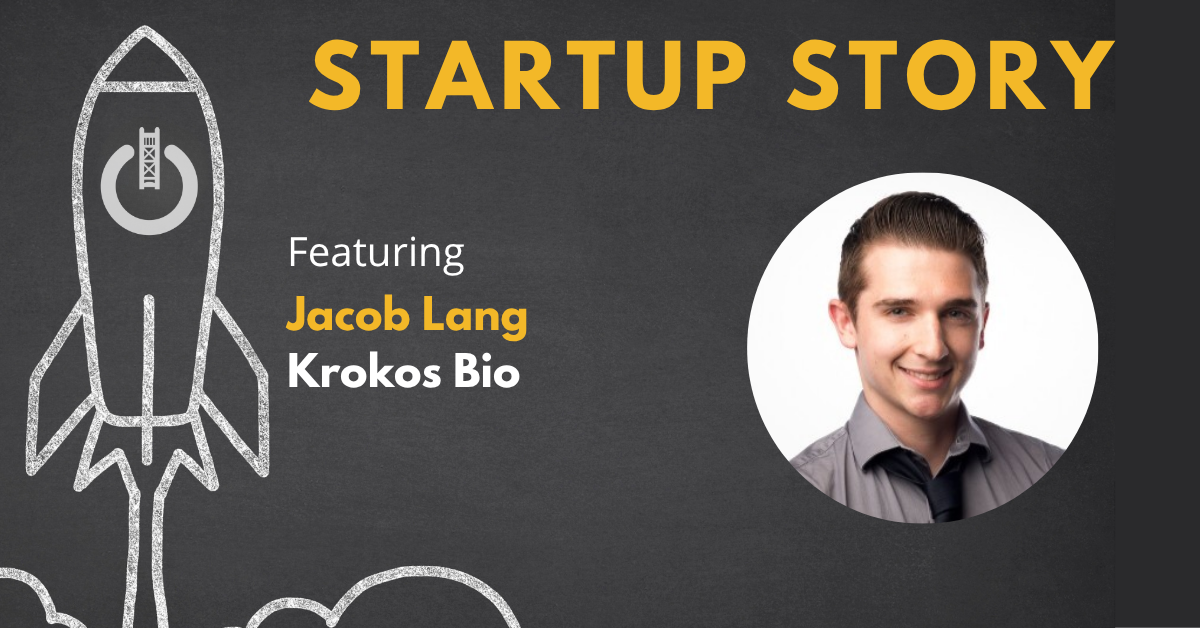
Krokos Bio is developing a biomanufacturing approach that uses plant cell culture to produce high-value botanical ingredients, beginning with saffron. Led by founder and CEO Jacob Lang, the company recently won first place at Pitch Elk Grove 2026, taking home the $10,000 grand prize.
In this Startup Story, Jacob answers our questions about the experiences that led him to entrepreneurship, how customer discovery helped shape Krokos Bio, the challenge of staying focused while building a technically complex startup, and why early stage founders should start talking with potential customers as soon as possible.
Note: Responses have been lightly edited for length and clarity.

From Biotechnology to Entrepreneurship
Before starting Krokos Bio, what did your career path look like, and what experiences ultimately led you to entrepreneurship?
Jacob: I’ve wanted to be an entrepreneur for most of my adult life. I’ve also been fascinated by biotechnology since I was a kid, which led me to study Biochemistry and Molecular Biology at UC Davis. While finishing my degree, I started working at Genentech’s Vacaville site, where I ran experiments to improve the conditions used to manufacture cancer drugs. This gave me exposure to how you take something that works in a lab and manufacture it reliably at commercial scale.
Around that time, I also worked with a startup founded by UC Davis engineering students and participated in the National Science Foundation’s I-Corps program. It taught me the importance of understanding a customer’s problem and then building the business around solving it. I later joined a biotech startup on its business development team before returning to bioprocess development at a large diagnostics and pharmaceutical company. Those experiences gave me deep exposure to both the technical and commercial sides of biotechnology.
What first made you recognize the challenges in sourcing rare botanicals as a business opportunity, and when did you realize it was something you wanted to build a company around?
Jacob: When evaluating various problems that could potentially be solved using biotechnology, I always started with the question: does it even make sense to use biotech? A lot of the time, the answer is no. Biotech is generally difficult, expensive, and can take years of investment before yielding results.
For biotech/biomanufacturing to actually make sense, the target product generally needs to:
- Be very expensive
- Be very hard to obtain
- Have large annual $$ demand
- Have no other feasible alternative that is acceptable to buyers
With that in mind, I came across articles about how droughts, floods, and crop disease affect global agriculture. This made me consider what those disruptions mean for plants that are already difficult to grow. I then found data on consistently high (and rising) prices of certain botanical ingredients. High prices usually encourage more production, but expanding supply is difficult when the plant itself creates constraints around where it can grow, how quickly it grows, or how it has to be harvested.
That observation led to the thesis behind Krokos Bio: if we could grow the plant cells that produce these valuable ingredients, we could overcome those production constraints and give buyers a more reliable supply. Their high value also meant there was a plausible path to profitability at relatively modest production volumes. That combination made this feel like a business worth building, with existing demand, a supply problem that biotechnology was well suited to address, and the potential to build a viable business early in our scale-up journey.
Why Krokos Bio Started With Saffron
Why did you decide to focus on saffron as Krokos Bio’s first product, and what made it the right starting point for proving your approach?
Jacob: Saffron is basically the “poster-child” for our thesis: it’s an extremely valuable and expensive ingredient with a large established demand. Producing it requires growing massive amounts of plants, harvesting has to be done by hand because the flower is so delicate, and most producers end up with very small amounts of material. That makes production very difficult to expand.
Supply is also highly concentrated: Iran produces roughly 85–90% of the world’s saffron, leaving buyers exposed to disruptions in a single region. Adulteration is also a persistent problem in the global saffron trade, creating another challenge for buyers who need confidence in the authenticity and quality of their ingredients. Alongside increasing supply, we’re working toward giving buyers a traceable source produced in a controlled environment, with consistent quality verified against their requirements.
Its value also makes it a compelling starting point for a new manufacturing approach. Even the lowest quality tier of saffron sells for over $1,000 per kilogram, giving us the potential to profitably sell product very early on and provide unique financial stability for a startup in our space.
What have you done to validate that there is a real market for what Krokos Bio is building, and what have you learned from potential customers or industry partners along the way?
Jacob: Customer discovery was a major part of our early validation work. We conducted more than 100 interviews through NSF I-Corps, including conversations with ingredient buyers, extract manufacturers, and consumer product companies. Those conversations helped us understand where supply problems create the most pain and what customers would need before adopting a new ingredient source. Consistency, traceability, and reliable access to the compounds they need have been recurring themes. Buyers are struggling to obtain the volumes and quality of saffron they need, which gives them a strong incentive to work with us as we develop an additional source.
We’ve shared our first round of samples with a select group of extract manufacturers and are now incorporating their feedback. That connects our development work directly to customer requirements and helps us prioritize the improvements that matter most to them. Beyond saffron, conversations with prospective customers helped us identify significant demand for other botanical ingredients. We recently signed a nonbinding memorandum of understanding with an established natural ingredient company for ~$6 million in estimated purchase demand for a future Krokos Bio product.
Staying Focused While Building
What has been one of the biggest challenges you have faced while building Krokos Bio, and how did you work through it?
Jacob: One of the biggest challenges has been maintaining focus. Plant cell culture has potential applications across many ingredients, and conversations with prospective customers can open up even more possibilities. It’s exciting, but every new direction takes time and resources. With a small team, we have to be deliberate about which opportunities we pursue. We’ve focused our near-term work on saffron, extract manufacturers and ingredient buyers as our target customers.
That gives us a practical way to evaluate decisions. We consider if each experiment, partnership, or opportunity helps us get closer to supplying those customers. We still keep track of other possibilities, but having a clear first market helps us put our effort where it matters most.
What did winning first place at Pitch Elk Grove mean for you and Krokos Bio, and what did you learn from the experience of preparing for and competing in the competition?
Jacob: Winning was really encouraging. So much of building a biotech company happens through experiments, customer conversations, and incremental progress that people outside the company don’t see. Having the opportunity to share that work and receive recognition from the local community meant a lot. Preparing for the competition also pushed me to get clearer about how I explain Krokos Bio, especially to a more general audience that might not be super familiar with our field.
Getting Specific Earlier
Looking back at the earliest stages of Krokos Bio, is there anything you would approach differently knowing what you know today?
Jacob: I would get more specific about our first customer and first application earlier. We started with a broad vision for what this technology could do, and I’m still excited about that vision. But building the first commercial product requires much narrower decisions. Even within saffron, different customers can have very different requirements. Choosing a clear initial application helps determine which experiments to run, what to measure, and which milestones matter most. If I were starting again, I’d work toward that level of specificity sooner. It makes it easier to connect day-to-day technical progress with the next step toward a sale.
What advice would you give to an early stage founder who has a technically complex or ambitious idea but is still figuring out how to turn it into a viable business?
Jacob: I’d definitely recommend to start talking to potential customers immediately. You can learn a huge amount while the technology is still being developed, and those conversations can help you decide what to build. You’re also very likely to get connections that will help you with your business later on (this has happened to me multiple times already).
Ask about how they work today, what problems cost them time or money, and what they’ve already tried. Then get specific about what adopting your solution would require: who makes the purchasing decision, what evidence they need, and how they would evaluate it.
About Krokos Bio
Krokos Bio is a biotechnology company developing plant cell culture as a way to produce high-value botanical ingredients. The company is beginning with saffron, an ingredient that is expensive to produce and dependent on a highly concentrated global supply chain.
Rather than relying exclusively on traditional cultivation and harvesting, Krokos Bio is working toward growing the plant cells responsible for producing valuable botanical ingredients in a controlled environment. The company is currently developing its saffron product, testing samples with extract manufacturers, gathering customer feedback, and exploring additional botanical ingredients with commercial demand.
Wrap Up
Krokos Bio’s journey highlights a challenge that many founders face, whether they are building a biotechnology company or a much simpler product: deciding where to focus.
The company began with a broad technology and a range of possible applications, but customer discovery helped narrow that opportunity into a specific initial product and target customer. More than 100 customer interviews, early product samples, and direct conversations with potential buyers have helped connect Krokos Bio’s technical development with commercial needs.
For early stage founders, the experience also reinforces the value of talking to customers before a product is finished. Understanding how customers currently solve a problem, what they need from a new solution, and how they make purchasing decisions can help determine what to build and where limited time and resources should go.
Interested in learning about more programs that support entrepreneurs? Join our newsletter here to stay updated on opportunities and resources.